

Gone are the days when a candidate was limited only to the tasks for which they were given the role. Today, the gap between having a job and mastering a role has never been wider. While companies are pouring billions into Learning and Development (L&D), a staggering percentage of these initiatives yield zero ROI. We have moved past the era where a simple slide deck could suffice; today’s workforce operates in an AI-augmented reality where skills become obsolete in months, not years.
If your organization is still relying on static modules, you are surely falling behind and actively losing talent. To understand the future, we must first diagnose why the past is broken.
Here is an in-depth look at why corporate training fails and how to pivot toward strategies that actually drive performance.
Still struggling with outdated training and poor ROI?
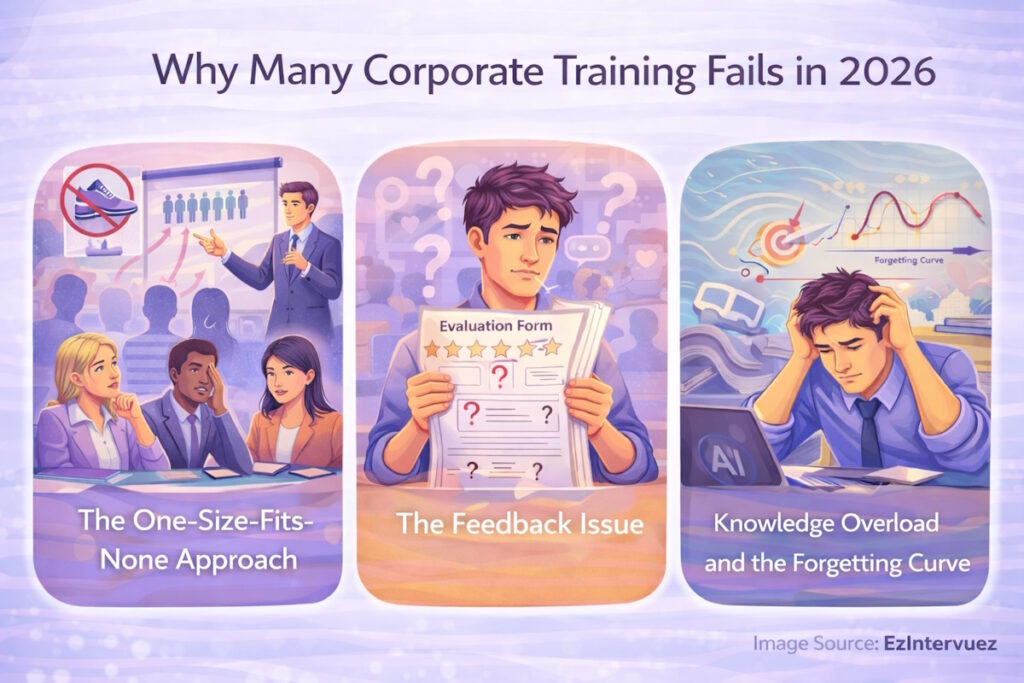
Why Many Corporate Training Fails in 2026
The primary reason why corporate training fails is that it treats learning as an event rather than a continuous process. In 2026, the once-a-year compliance workshop is viewed by employees as a digital tax on their time rather than a benefit, much like the ongoing debate of training institutes vs recruiters.
1. The One-Size-Fits-None Approach
Traditional programs suffer from extreme rigidity. When you force a senior developer and a junior marketing associate through the same Leadership 101 module, you alienate both. Generic content lacks the nuance required for high-level execution, leading to one of the most common employee training problems: chronic disengagement. If the content does not feel immediately relevant to an individual’s daily workflow, the brain naturally filters it out as noise.
2. The Feedback Issue
In the past, feedback was a post-training survey asking if the lunch was good. Today, that isn’t enough. Without real-time, data-driven feedback, employees have no way of knowing if they are applying new skills correctly. This lack of correction in the moment is one of the leading corporate training challenges facing global firms. When an employee practices a new skill in a vacuum, they often reinforce bad habits rather than develop good ones.
3. Knowledge Overload and the Forgetting Curve
The human brain is not designed to retain three hours of video content in one sitting. Research shows that without immediate application, 70% of new information is forgotten within 24 hours. Traditional training fails because it prioritizes completion over retention. We see this in the massive dropout rates for massive open online courses (MOOCs), which often prioritize volume over value.
Modern Employee Training Problems in 2026
As we navigate 2026, new hurdles have emerged that make legacy systems even more obsolete.
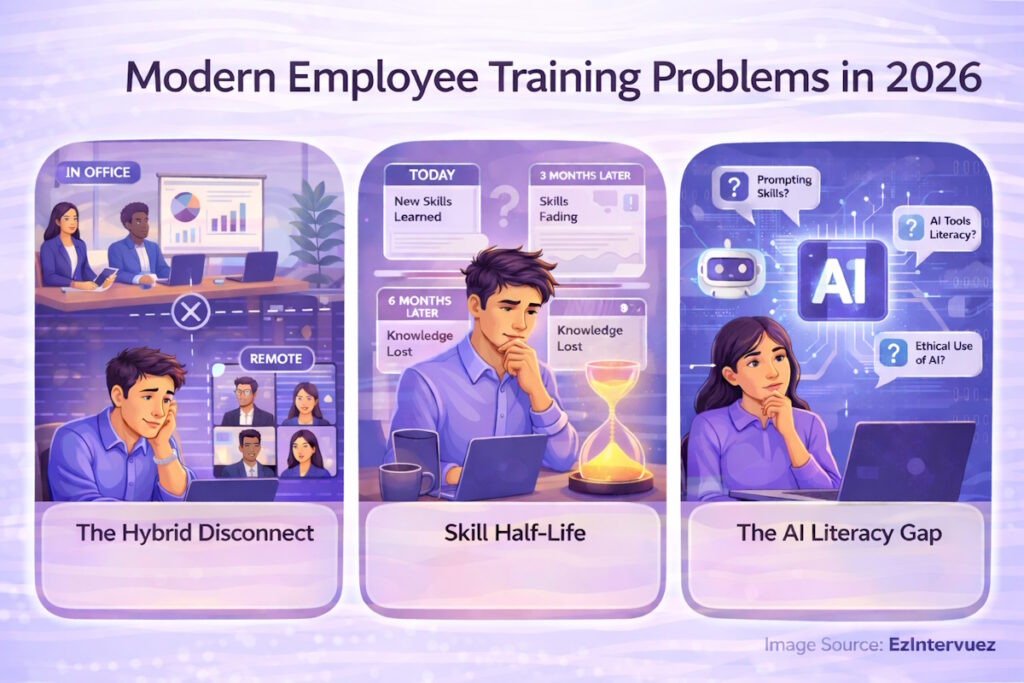
- The Hybrid Disconnect: With teams split between the metaverse, home offices, and physical hubs, synchronous classroom-style training is a logistical nightmare. People want flexibility, and forcing them into a specific time slot for training creates resentment.
- Skill Half-Life: The half-life of a professional skill is now estimated at less than five years. In technical fields, it can be as short as eighteen months. If your training cycle takes six months to develop, the content is outdated before it even launches.
- The AI Literacy Gap: Many employees feel overwhelmed by the rapid integration of automation. AI training is no longer a nice-to-have elective; it is the core infrastructure of modern work. If your team does not know how to prompt or manage AI agents, they are essentially working with one hand tied behind their backs.
Deep Dive into Corporate Training Challenges in 2026
To truly understand why corporate training fails, we must look at the psychological and structural barriers within modern organizations. Often, the culture itself is resistant to learning.
Lack of Managerial Support
One of the silent employee training problems is the disconnect between the L&D department and front-line managers. If a manager does not see the value in a training program, they will not give their team the time to complete it properly. Employees are caught in a crossfire between wanting to learn and needing to hit their immediate KPIs.
Poor User Experience (UX)
Most corporate Learning Management Systems (LMS) look like they were designed in 2005. They are clunky, slow, and difficult to navigate. In a world where employees use sleek, AI-driven apps in their personal lives, they have zero patience for a frustrating corporate interface. This friction is a major reason why corporate training challenges persist despite high budgets.
Want to fix your training gaps and improve ROI?
How to Overcome the Hurdles and What Works Now
The organizations winning the war for talent in 2026 have shifted their philosophy. They have moved away from pushing content to pulling performance.
Here is the blueprint for success:
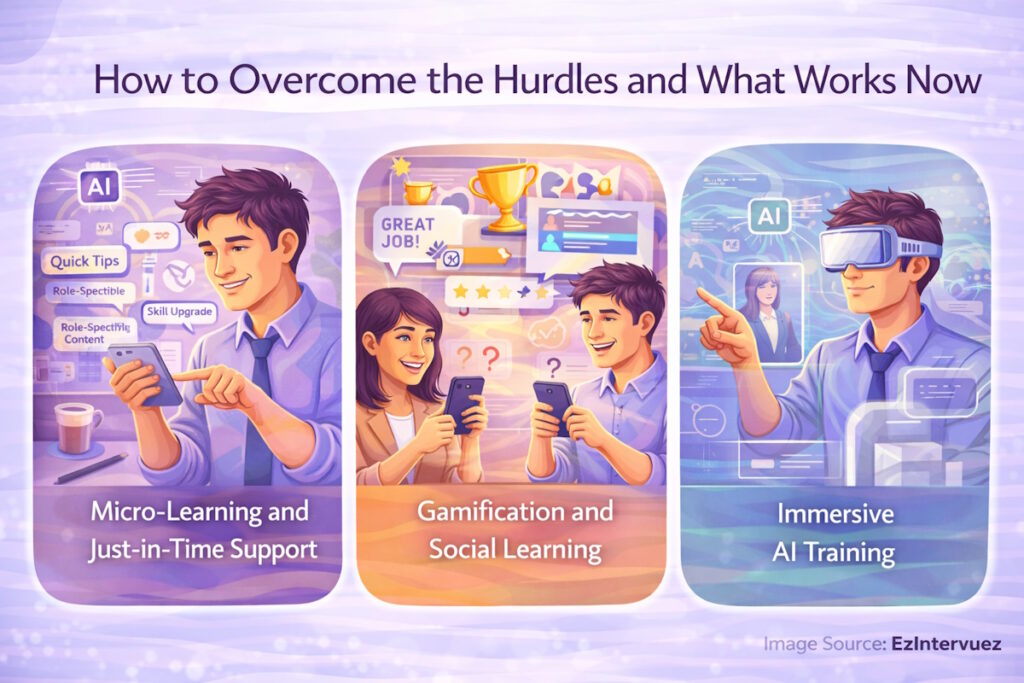
1. Micro-Learning and Just-in-Time Support
Instead of day-long seminars, successful companies use burst learning. These are 2 to 5-minute modules delivered exactly when an employee needs them. If a sales rep is about to enter a high-stakes negotiation, they do not need a 40-page PDF; they need a 90-second refresher on objection handling. This approach respects the employee’s time and maximizes retention.
2. Gamification and Social Learning
Humans are inherently social and competitive. Introducing leaderboards, badges, and peer-to-peer coaching, training becomes an interactive experience. This addresses one of the biggest reasons why corporate training fails: the lack of motivation. When employees can see their progress relative to their peers, they are more likely to stay engaged.
3. Immersive AI Training
In 2026, AI training is the cornerstone of every department. This involves teaching employees how to use AI co-pilots to automate repetitive tasks that allow them to focus on high-value strategy and creative problem-solving. This type of training needs to be hands-on. You cannot learn how to work with AI by watching a video; you have to do it.
The Role of AI in Corporate Training Scaling Excellence
Artificial Intelligence has transformed from a buzzword into the primary engine of L&D. Through AI training tools, companies can now offer:
- Hyper-Personalization: AI analyzes an employee’s current performance data to suggest specific modules that fill their unique skill gaps.
- Predictive Analytics: Identifying which employees are likely to struggle with a new software rollout before it even happens. This allows for proactive intervention rather than reactive damage control.
- Adaptive Assessments: Quizzes that get harder or easier based on the learner’s responses, ensuring they stay in the Goldilocks Zone of learning. This prevents boredom for advanced learners and frustration for beginners.
The Psychological Shift is From Corporate Training to Enablement
The reason why corporate training fails is often found in the terminology. Training implies something done to an employee. Enablement implies giving an employee the tools they need to succeed. In 2026, the best companies focus on Performance Enablement.
This means integrating learning into the tools employees already use, such as Slack, Microsoft Teams, or specialized CRM platforms. When learning happens within the flow of work, it ceases to be a chore and becomes a resource. This shift effectively solves many employee training problems related to time management and relevance.
The Future of Corporate Training is AI-powered EzIntervuez
If you are looking to solve the riddle of why corporate training fails, you need a tool that moves as fast as the market. Enter EzIntervuez, an AI-powered platform designed to revolutionize how we assess and develop corporate talent.
While many know EzIntervuez as a hiring powerhouse, its Corporate Training Use Case is where the real magic happens for existing teams. It tackles the most stubborn employee training problems by providing a safe, intelligent environment for skill mastery.
How EzIntervuez Solves Corporate Training Challenges in 2026
In an era where AI training is vital, EzIntervuez does not just teach you about AI; it uses AI to make you a better human. It reduces the time-to-productivity for new hires by 3x and has been shown to reduce employee turnover by up to 78% by fostering a culture of continuous improvement and clear career pathways.
Providing a platform where employees can fail safely and learn quickly, EzIntervuez removes the fear factor from professional development. This psychological safety is essential for solving employee training problems related to confidence and skill acquisition.
Here is how the AI-powered corporate training tool helps:
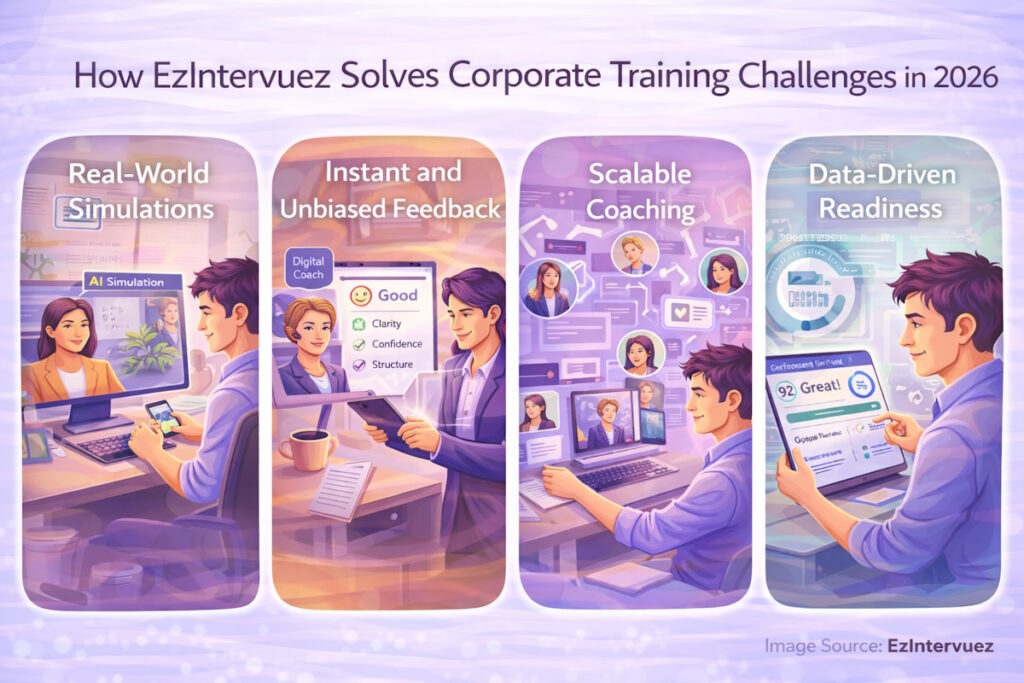
- Real-World Simulations: Instead of reading about Conflict Resolution, employees engage in AI-driven mock interviews and role-play scenarios. The AI acts as a disgruntled client or a challenging direct report, providing a lifelike practice ground. This experiential learning is the key to overcoming the forgetting curve.
- Instant and Unbiased Feedback: After a session, EzIntervuez provides a detailed breakdown of performance. It analyzes everything from keyword usage and technical accuracy to soft skills like tone, pace, and confidence. This level of granularity was previously impossible without expensive human coaches.
- Scalable Coaching: One of the biggest corporate training challenges is that human mentors do not scale. A senior leader only has so many hours in a day. EzIntervuez allows 1,000 employees to receive 1-on-1 coaching simultaneously, ensuring consistency and quality across the entire organization.
- Data-Driven Readiness: Managers no longer have to guess if a team is ready for a promotion or a new project. The platform provides a Job-Fit Score based on actual performance in simulated environments. This data is invaluable for succession planning and talent mapping.
Case Study: A Transformation in Action
Consider a global tech firm facing massive corporate training challenges with its sales department. Their traditional webinars were resulting in a 5% completion rate and stagnant sales figures. Switching to a model powered by AI training and platforms like EzIntervuez, they implemented weekly 10-minute simulation challenges.
Within three months:
- Sales conversion rates increased by 22%.
- Employee satisfaction scores regarding professional development rose by 45%.
- The time spent on training actually decreased, but the impact of that time tripled.
This is the power of moving away from the reasons why corporate training fails and toward what actually works in 2026.
With EzIntervuez, You Train and Transform Corporate Employees
The reason why corporate training fails is often a lack of vision and a reliance on outdated delivery methods. In 2026, we cannot afford to treat our employees like passive recipients of information. We must treat them like athletes who need a gym, a coach, and real-time stats to win.
Addressing the core employee training problems of the past and embracing the AI tools of the future, you can turn your L&D department from a cost center into a competitive advantage. The digital era demands agility, and your training programs must reflect that.
Ready to stop checking boxes and start building experts? Explore how EzIntervuez can transform your corporate training strategy today. Whether it is upskilling your current team or ensuring your next 100 hires are top-tier, the future of work is built on intelligent, interactive preparation. Stop letting corporate training challenges hold your organization back and start investing in what actually works.
